Saint Michael's Maronite Catholic Church of Koubbeh, Tripoli, Lebanon
St. Michael the Archangel

St. Michael is one of the principal angels; his name was the war-cry of the
good angels in the battle fought in heaven against the enemy and his followers.
Four times his name is recorded in Scripture: (1) Daniel 10:13 sqq., Gabriel says to Daniel, when he asks God to
permit the Jews to return to Jerusalem: "The Angel [D.V. prince] of the kingdom
of the Persians resisted me . . . and, behold Michael, one of the chief princes,
came to help me . . . and none is my helper in all these things, but Michael
your prince"; (2) Daniel 12, the Angel speaking of the end of the world and the
Antichrist says: "At that time shall Michael rise up, the great prince, who
standeth for the children of thy people." (3) In the Catholic Epistle of St. Jude: "When Michael the Archangel,
disputing with the devil, contended about the body of Moses", etc. St. Jude
alludes to an ancient Jewish tradition of a dispute between Michael and Satan
over the body of Moses, an account of which is also found in the apocryphal book
on the assumption of Moses (Origen, "De principiis", III, 2, 2). St. Michael
concealed the tomb of Moses; Satan, however, by disclosing it, tried to seduce
the Jewish people to the sin of hero-worship. St. Michael also guards the body
of Eve, according to the "Revelation of Moses" ("Apocryphal Gospels", etc., ed.
A. Walker, Edinburgh, p. 647). (4) Apocalypse 12:7, "And there was a great battle in heaven, Michael
and his angels fought with the dragon." St. John speaks of the great conflict at
the end of time, which reflects also the battle in heaven at the beginning of
time. According to the Fathers there is often question of St. Michael in
Scripture where his name is not mentioned. They say he was the cherub who stood
at the gate of paradise, "to keep the way of the tree of life" (Gen., iii, 24),
the angel through whom God published the Decalogue to his chosen people, the
angel who stood in the way against Balaam (Numbers 22:22 sqq.), the angel who
routed the army of Sennacherib (IV Kings 19:35). Following these Scriptural passages, Christian tradition gives to St. Michael
four offices: Regarding his rank in the celestial hierarchy opinions vary; St. Basil (Hom.
de angelis) and other Greek Fathers, also Salmeron, Bellarmine, etc., place St.
Michael over all the angels; they say he is called "archangel" because he is the
prince of the other angels; others (cf. P. Bonaventura, op. cit.) believe that
he is the prince of the seraphim, the first of the nine angelic orders. But,
according to St. Thomas (Summa, I:113:3) he is the prince of the last and lowest
choir, the angels. The Roman Liturgy seems to follow the Greek Fathers; it calls
him "Princeps militiae coelestis quem honorificant angelorum cives". The hymn of
the Mozarabic Breviary places St. Michael even above the Twenty-four Elders. The
Greek Liturgy styles him Archistrategos, "highest general" (cf. Menaea, 8
Nov. and 6 Sept.). VENERATION It would have been natural to St. Michael, the champion of the Jewish people,
to be the champion also of Christians, giving victory in war to his clients. The
early Christians, however, regarded some of the martyrs as their military
patrons: St. George, St. Theodore, St. Demetrius, St. Sergius, St. Procopius,
St. Mercurius, etc.; but to St. Michael they gave the care of their sick. At the
place where he was first venerated, in Phrygia, his prestige as angelic healer
obscured his interposition in military affairs. It was from early times the
centre of the true cult of the holy angels, particularly of St. Michael.
Tradition relates that St. Michael in the earliest ages caused a medicinal
spring to spout at Chairotopa near Colossae, where all the sick who bathed
there, invoking the Blessed Trinity and St. Michael, were cured. Still more famous are the springs which St. Michael is said to have drawn
from the rock at Colossae (Chonae, the present Khonas, on the Lycus). The pagans
directed a stream against the sanctuary of St. Michael to destroy it, but the
archangel split the rock by lightning to give a new bed to the stream, and
sanctified forever the waters which came from the gorge. The Greeks claim that
this apparition took place about the middle of the first century and celebrate a
feast in commemoration of it on 6 September (Analecta Bolland., VIII, 285-328).
Also at Pythia in Bithynia and elsewhere in Asia the hot springs were dedicated
to St. Michael. At Constantinople likewise, St. Michael was the great heavenly physician. His
principal sanctuary, the Michaelion, was at Sosthenion, some fifty miles south
of Constantinople; there the archangel is said to have appeared to the Emperor
Constantine. The sick slept in this church at night to wait for a manifestation
of St. Michael; his feast was kept there 9 June. Another famous church was
within the walls of the city, at the thermal baths of the Emperor Arcadius;
there the synaxis of the archangel was celebrated 8 November. This feast spread
over the entire Greek Church, and the Syrian, Armenian, and Coptic Churches
adopted it also; it is now the principal feast of St. Michael in the Orient. It
may have originated in Phrygia, but its station at Constantinople was the
Thermae of Arcadius (Martinow, "Annus Graeco-slavicus", 8 Nov.). Other feasts of
St. Michael at Constantinople were: 27 October, in the "Promotu" church; 18
June, in the Church of St. Julian at the Forum; and 10 December, at Athaea. The Christians of Egypt placed their life-giving river, the Nile under the
protection of St. Michael; they adopted the Greek feast and kept it 12 November;
on the twelfth of every month they celebrate a special commemoration of the
archangel, but 12 June, when the river commences to rise, they keep as a holiday
of obligation the feast of St. Michael "for the rising of the Nile", euche
eis ten symmetron anabasin ton potamion hydaton. At Rome the Leonine Sacramentary (sixth century) has the "Natale Basilicae
Angeli via Salaria", 30 September; of the five Masses for the feast three
mention St. Michael. The Gelasian Sacramentary (seventh century) gives the feast
"S. Michaelis Archangeli", and the Gregorian Sacramentary (eighth century),
"Dedicatio Basilionis S. Angeli Michaelis", 29 Sept. A manuscript also here adds
"via Salaria" (Ebner, "Miss. Rom. Iter Italicum", 127). This church of the Via
Salaria was six miles to the north of the city; in the ninth century it was
called Basilica Archangeli in Septimo (Armellini, "Chiese di Roma", p.
85). It disappeared a thousand years ago. At Rome also the part of heavenly
physician was given to St. Michael. According to an (apocryphal?) legend of the
tenth century he appeared over the Moles Hadriani (Castel di S. Angelo), in 950,
during the procession which St. Gregory held against the pestilence, putting an
end to the plague. Boniface IV (608-15) built on the Moles Hadriani in honour of
him, a church, which was styled St. Michaelis inter nubes (in summitate
circi). Well known is the apparition of St. Michael (a. 494 or 530-40), as related in
the Roman Breviary, 8 May, at his renowned sanctuary on Monte Gargano, where his
original glory as patron in war was restored to him. To his intercession the
Lombards of Sipontum (Manfredonia) attributed their victory over the Greek
Neapolitans, 8 May, 663. In commemoration of this victory the church of Sipontum
instituted a special feast in honour of the archangel, on 8 May, which has
spread over the entire Latin Church and is now called (since the time of Pius V)
"Apparitio S. Michaelis", although it originally did not commemorate the
apparition, but the victory. In Normandy St. Michael is the patron of mariners in his famous sanctuary at
Mont-Saint-Michel in the diocese of Coutances. He is said to have appeared
there, in 708, to St. Aubert, Bishop of Avranches. In Normandy his feast "S.
Michaelis in periculo maris" or "in Monte Tumba" was universally celebrated on
18 Oct., the anniversary of the dedication of the first church, 16 Oct., 710;
the feast is now confined to the Diocese of Coutances. In Germany, after its
evangelization, St. Michael replaced for the Christians the pagan god Wotan, to
whom many mountains were sacred, hence the numerous mountain chapels of St.
Michael all over Germany. The hymns of the Roman Office are said to have been composed by St. Rabanus
Maurus of Fulda (d. 856). In art St. Michael is represented as an angelic
warrior, fully armed with helmet, sword, and shield (often the shield bears the
Latin inscription: Quis ut Deus), standing over the dragon, whom he sometimes
pierces with a lance. He also holds a pair of scales in which he weighs the
souls of the departed (cf. Rock, "The Church of Our Fathers", III, 160), or the
book of life, to show that he takes part in the judgment. His feast (29
September) in the Middle Ages was celebrated as a holy day of obligation, but
along with several other feasts it was gradually abolished since the eighteenth
century. Michaelmas Day, in England and other countries, is one of the regular
quarter-days for settling rents and accounts; but it is no longer remarkable for
the hospitality with which it was formerly celebrated. Stubble-geese being
esteemed in perfection about this time, most families had one dressed on
Michaelmas Day. In some parishes (Isle of Skye) they had a procession on this
day and baked a cake, called St. Michael's bannock. FREDERICK G. HOLWECK 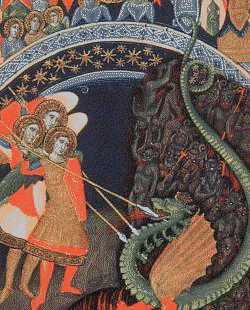 (Hebrew "Who is like
God?").
(Hebrew "Who is like
God?").
Transcribed from the 1913 Catholic Encyclopedia
by
Scott Van Baaren.
Other References about St. Michael the Archangel
Patron Saint of the Police
St. Michael and St. Paul of the Cross
Main Page
Church History
Church Baptismal, Marriage, and Death Records
Church Photo Gallery
St Michael's References
St Michael's Pictures and Icons
St Michael's Prayers
Angel's Definitions
St Michael's Apparitions
Sign Guestbook
View Guestbook
For additional information, questions or comments about this web site, please e-mail Raymond Maurice Khoury Hanna Dib in New York, USA
Thank you for being visitor number since January 10, 2000 This page was last updated on :
Copyright © 2000 Saint Michael Maronite Church ot Koubbeh, Tripoli, Lebanon.